Course Content
INTRODUCTION TO FINANCIAL STATEMENT ANALYSIS
This topic covers the LOS (Learning Outcome Statements) 19 as covered by the CFA institute. According to this statement, after going through this reading, a student shall be able to: a. Describe the role of financial reporting and financial statement analysis. b. Describe the role of key financial statements, i.e. i. Statement of financial position, ii. Statement of comprehensive income, iii. Statement of changes in equity, and iv. Statement of cash flows. c. Describe the importance of financial statement notes and supplementary information. This includes: i. Disclosures of accounting policies, ii. Methods, and iii. Estimates used in financial reporting. d. Describe the: i. Objectives of audit of financial statements, ii. the types of audit reports, and iii. the importance of effective internal controls. e. Identify and describe information sources that analysts use in financial statement analysis besides annual financial statements and supplementary information; f. Describe the steps in the financial statement analysis framework.
0/8
FINANCIAL REPORTING STANDARDS
This part of the study session 6 is covered under the LOS (Learning Outcome Statement) 20, as covered by the CFA institute. After going through this chapter, a student shall be able to: a. describe the objective of financial statements and the importance of financial reporting standards in security analysis and valuation; b. describe roles and desirable attributes of financial reporting standard-setting bodies and regulatory authorities in establishing and enforcing reporting standards, and describe the role of the International Organization of Securities Commissions; c. describe the International Accounting Standards Board’s conceptual framework, including the objective and qualitative characteristics of financial statements, required reporting elements, and constraints and assumptions in preparing financial statements; d. describe general requirements for financial statements under International Financial Reporting Standards (IFRS); e. describe implications for the financial analysis of differing financial reporting systems and the importance of monitoring developments in financial reporting standards; analyze company disclosures of significant accounting policies. There are revisions and amendments that keep happening to the existing financial reporting standards o n a regular basis. It is thus advisable to the students to keep updating themselves regarding such changes to maintain a decent understanding regarding the financial reporting framework towards a better analysis.
0/7
UNDERSTANDING INCOME STATEMENTS
This part of the study session 7 is covered under the LOS (Learning Outcome Statement) 21, as covered by the CFA institute. After going through this chapter, a student shall be able to: a. describe the components of the income statement and alternative presentation formats of that statement; b. describe general principles of revenue recognition and accrual accounting, specific revenue recognition applications (including accounting for long-term contracts, installment sales, barter transactions, gross and net reporting of revenue), and implications of revenue recognition principles for financial analysis; c. calculate revenue given information that might influence the choice of revenue recognition method; d. describe general principles of expense recognition, specific expense recognition applications, and implications of expense recognition choices for financial analysis; e. describe the financial reporting treatment and analysis of non-recurring items (including discontinued operations, extraordinary items, unusual or infrequent items) and changes in accounting standards; f. distinguish between the operating and non-operating components of the income statement; g. describe how earnings per share are calculated and calculate and interpret a company’s earnings per share (both basic and diluted earnings per share) for both simple and complex capital structures; h. distinguish between dilutive and anti-dilutive securities, and describe the implications of each for the earnings per share calculation; i. convert income statements to common-size income statements; j. evaluate a company’s financial performance using common-size income statements and financial ratios based on the income statement; k. describe, calculate, and interpret comprehensive income; l. describe other comprehensive income, and identify major types of items included in it.
0/8
UNDERSTANDING BALANCE SHEETS
This part of the study session 7 is covered under the Reading 22, as covered by the CFA institute. After going through this chapter, a student shall be able to: a. describe the elements of the balance sheet: assets, liabilities, and equity; b. describe uses and limitations of the balance sheet in financial analysis; c. describe alternative formats of balance sheet presentation; d. distinguish between current and non-current assets, and current and non-current liabilities; e. describe different types of assets and liabilities and the measurement bases of each; f. describe the components of shareholders’ equity; g. convert balance sheets to common-size balance sheets and interpret common-size balance sheets; h. calculate and interpret liquidity and solvency ratios.
0/8
UNDERSTANDING CASH FLOW STATEMENTS
This part of the study session 7 is covered under the Reading 23, as covered by the CFA institute. After going through this chapter, a student shall be able to: a. compare cash flows from operating, investing, and financing activities and classify cash flow items as relating to one of those three categories given a description of the items; b. describe how non-cash investing and financing activities are reported; c. contrast cash flow statements prepared under International Financial Reporting Standards (IFRS) and US generally accepted accounting principles (US GAAP); d. distinguish between the direct and indirect methods of presenting cash from operating activities and describe arguments in favor of each method; e. describe how the cash flow statement is linked to the income statement and the balance sheet; f. describe the steps in the preparation of direct and indirect cash flow statements, including how cash flows can be computed using income statement and balance sheet data; g. convert cash flows from the indirect to direct method; h. analyze and interpret both reported and common-size cash flow statements; i. calculate and interpret free cash flow to the firm, free cash flow to equity, and performance and coverage cash flow ratios.
0/10
FINANCIAL ANALYSIS TECHNIQUES
This part of the study session 7 is covered under the Reading 24, as covered by the CFA institute. After going through this chapter, a student shall be able to: a. describe tools and techniques used in financial analysis, including their uses and limitations; b. classify, calculate, and interpret activity, liquidity, solvency, profitability, and valuation ratios; c. describe relationships among ratios and evaluate a company using ratio analysis; d. demonstrate the application of DuPont analysis of return on equity, and calculate and interpret effects of changes in its components; e. calculate and interpret ratios used in equity analysis and credit analysis; f. explain the requirements for segment reporting, and calculate and interpret segment ratios; g. describe how ratio analysis and other techniques can be used to model and forecast earnings.
0/7
INVENTORIES
This part of the study session 8 is covered under Reading 25, as covered by the CFA Institute. The candidate should be able to: a distinguish between costs included in inventories and costs recognised as expenses in the period in which they are incurred; b describe different inventory valuation methods (cost formulas); c calculate and compare cost of sales, gross profit, and ending inventory using different inventory valuation methods and using perpetual and periodic inventory systems; d calculate and explain how inflation and deflation of inventory costs affect the financial statements and ratios of companies that use different inventory valuation methods; e explain LIFO reserve and LIFO liquidation and their effects on financial statements and ratios; f convert a company’s reported financial statements from LIFO to FIFO for purposes of comparison; g describe the measurement of inventory at the lower of cost and net realisable value; h describe implications of valuing inventory at net realisable value for financial statements and ratios; i describe the financial statement presentation of and disclosures relating to inventories; j explain issues that analysts should consider when examining a company’s inventory disclosures and other sources of information; k calculate and compare ratios of companies, including companies that use different inventory methods; l analyze and compare the financial statements of companies, including companies that use different inventory methods.
0/10
LONG-LIVED ASSETS
This part the study session 8 is covered under Reading 26, as covered by the CFA Institute. After reading this chapter a candidate should be able to: a. distinguish between costs that are capitalised and costs that are expensed in the period in which they are incurred; b. compare the financial reporting of the following types of intangible assets: purchased, internally developed, acquired in a business combination; c. explain and evaluate how capitalising versus expensing costs in the period in which they are incurred affects financial statements and ratios; d. describe the different depreciation methods for property, plant, and equipment and calculate depreciation expense; e. describe how the choice of depreciation method and assumptions concerning useful life and residual value affect depreciation expense, financial statements, and ratios; f. describe the different amortisation methods for intangible assets with finite lives and calculate amortisation expense; g. describe how the choice of amortisation method and assumptions concerning useful life and residual value affect amortisation expense, financial statements, and ratios; h. describe the revaluation model; i. explain the impairment of property, plant, and equipment and intangible assets; j. explain the derecognition of property, plant, and equipment and intangible assets; k. explain and evaluate how impairment, revaluation, and derecognition of property, plant, and equipment and intangible assets affect financial statements and ratios; l. describe the financial statement presentation of and disclosures relating to property, plant, and equipment and intangible assets; m. analyze and interpret financial statement disclosures regarding property, plant, and equipment and intangible assets; n. compare the financial reporting of investment property with that of property, plant, and equipment.
0/16
INCOME TAXES
This part of the study session 8 is covered under Reading 28, as covered by the CFA Institute. After reading this chapter a candidate should be able to: a. describe the differences between accounting profit and taxable income, and define key terms, including deferred tax assets, deferred tax liabilities, valuation allowance, taxes payable, and income tax expense; b. explain how deferred tax liabilities and assets are created and the factors that determine how a company’s deferred tax liabilities and assets should be treated for the purposes of financial analysis; c. calculate the tax base of a company’s assets and liabilities; d. calculate income tax expense, income taxes payable, deferred tax assets, and deferred tax liabilities, and calculate and interpret the adjustment to the financial statements related to a change in the income tax rate; e. evaluate the impact of tax rate changes on a company’s financial statements and ratios; f. distinguish between temporary and permanent differences in pre-tax accounting income and taxable income; g. describe the valuation allowance for deferred tax assets—when it is required and what impact it has on financial statements; h. compare a company’s deferred tax items; i. analyze disclosures relating to deferred tax items and the effective tax rate reconciliation, and explain how information included in these disclosures affects a company’s financial statements and financial ratios; j. identify the key provisions of and differences between income tax accounting under International Financial Reporting Standards (IFRS) and the US generally accepted accounting principles (GAAP).
0/11
NON-CURRENT (LONG-TERM) LIABILITIES
This part of the study session 8 is covered under Reading 28, as covered by the CFA Institute. After reading this chapter a candidate should be able to: a. determine the initial recognition, initial measurement, and subsequent measurement of bonds; b. describe the effective interest method and calculate interest expense, amortization of bond discounts/premiums, and interest payments; c. explain the derecognition of debt; d. describe the role of debt covenants in protecting creditors; e. describe the financial statement presentation of and disclosures relating to debt; f. explain motivations for leasing assets instead of purchasing them; g. explain the financial reporting of leases from a lessee’s perspective; h. explain the financial reporting of leases from a lessor’s perspective; i. compare the presentation and disclosure of defined contribution and defined benefit pension plans; j. calculate and interpret leverage and coverage ratios.
0/11
FINANCIAL REPORTING QUALITY
This part of the study session 9 is covered under Reading 29, as covered by the CFA Institute. After reading this chapter a candidate should be able to: a. distinguish between financial reporting quality and quality of reported results (including quality of earnings, cash flow, and balance sheet items); b. describe a spectrum for assessing financial reporting quality; c. distinguish between conservative and aggressive accounting; d. describe motivations that might cause management to issue financial reports that are not high quality; e. describe conditions that are conducive to issuing low-quality, or even fraudulent, financial reports; f. describe mechanisms that discipline financial reporting quality and the potential limitations of those mechanisms; g. describe presentation choices, including non-GAAP measures, that could be used to influence an analyst’s opinion; h. describe accounting methods (choices and estimates) that could be used to manage earnings, cash flow, and balance sheet items; i. describe accounting warning signs and methods for detecting manipulation of information in financial reports.
0/10
APPLICATIONS OF FINANCIAL STATEMENT ANALYSIS
This part of the study session 9 is covered under Reading 30, as covered by the CFA Institute. After reading this chapter a candidate should be able to: a. evaluate a company’s past financial performance and explain how a company’s strategy is reflected in past financial performance; b. forecast a company’s future net income and cash flow; c. describe the role of financial statement analysis in assessing the credit quality of a potential debt investment; d. describe the use of financial statement analysis in screening for potential equity investments; e. explain appropriate analyst adjustments to a company’s financial statements to facilitate comparison with another company.
0/6
Financial Reporting and Analysis

LOS C requires us to:

describe the International Accounting Standards Board’s conceptual framework, including qualitative characteristics of financial reports, constraints on financial reports, and required reporting elements.

‘Conceptual Framework for Financial Reporting’, which was adopted in the year 2010 forms the base upon which the IASB sets its standards. The financial reporting framework prescribes the qualitative characteristics and required reporting elements based upon which the IFRS are prepared. The framework also acknowledges the constraints and the assumptions that go into preparing the standards. The framework is basically aimed at providing the standards that are useful for all the users of financial statements such as shareholders, lenders, creditors, etc.

1.         Qualitative Characteristics of Financial Reports

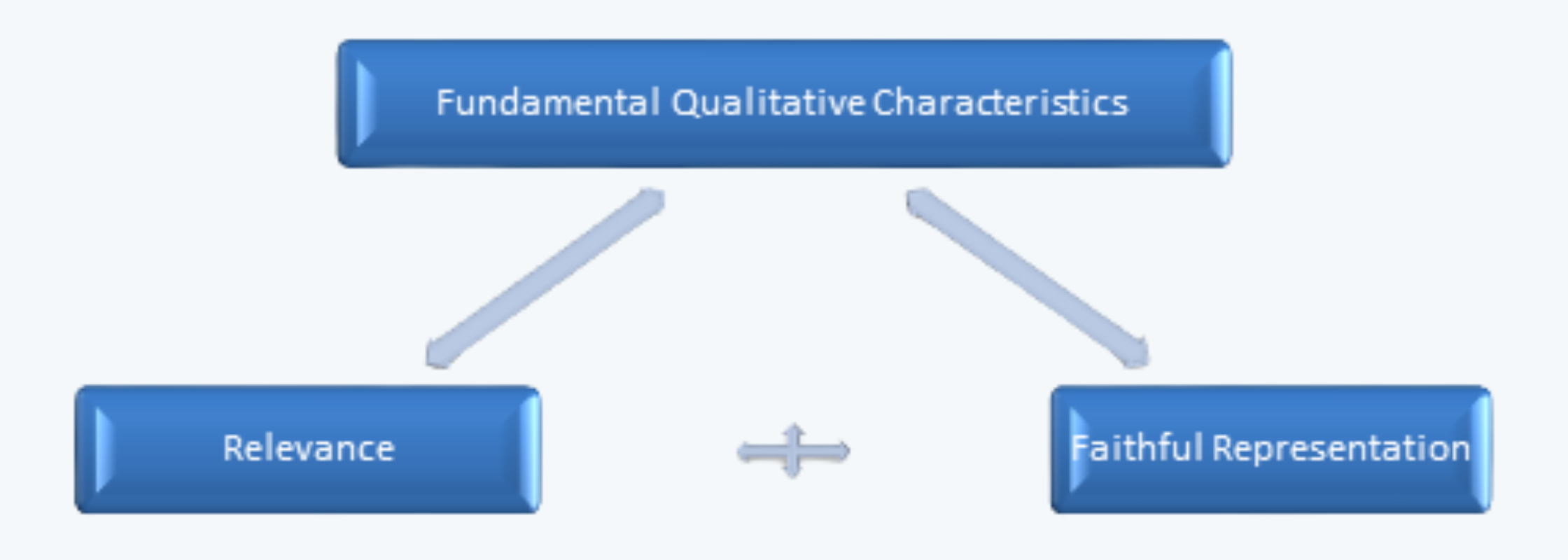
There are two fundamental qualitative characteristics, as identified by the conceptual frameworks, which make the financial information as reported in the reports useful to its users. They are:
Fundamental Qualitative Characteristcs FRA CFA Level 1 Study Notes

a.  Relevance. The information is considered relevant if it affects the user’s decision-making and it has some value. The information could either have predictive value (useful in making forecasts), confirmatory value (useful to evaluate past decisions or forecasts), or both. Also, the information’s value should be at least enough to have an influence on the decision of the users, and its omission could badly influence the users of such information (i.e. it should be material enough).

b.  Faithful Representation. Information is considered as faithfully represented if it is:

     i.  complete, in the sense that it covers all the economic data and other data necessary for the users to form an opinion;

    ii.  unbiased, in the sense that it should not be influenced by the personal benefits of any of its beneficiaries; and

   iii.  free from error, either intentional or unintentionally due to omission or commission, etc.

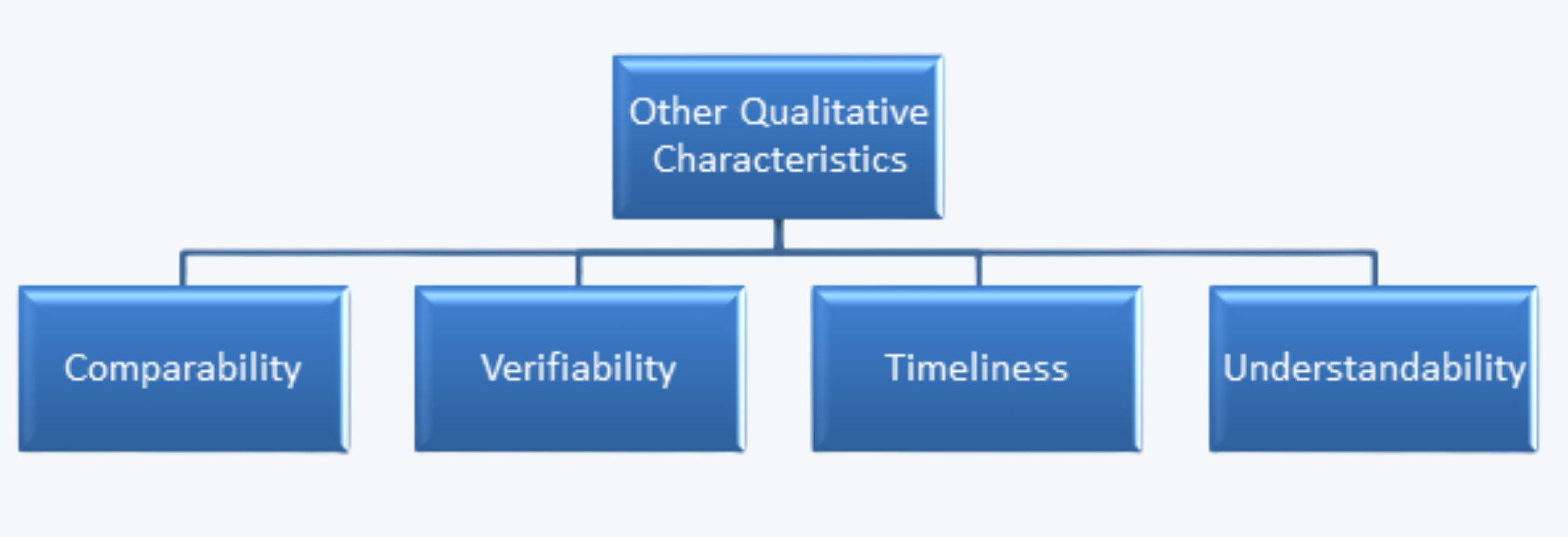
Besides these two fundamental qualitative characteristics, the Conceptual Framework (2010) identifies four characteristics that enhance the usefulness of relevant and faithfully represented financial information. They are:
Qualitative Characteristics of Financial Reports FRA CFA Level 1 Study Notes

     i.  Comparability.  The information that is provided by the financial reports should be compared not only across different entities but also within the same entity, across different periods. Comparisons make the analysis of the information easier.

    ii.  Verifiability means that different knowledgeable and independent observers would agree that the information presented faithfully represents the economic phenomena it purports to represent.

   iii.  Timeliness. Timely information is available to decision-makers prior to their making a decision.

   iv.  Understandability. Obviously, all the financial information is not understandable by every other layman. But, it should be understandable for a person having reasonable knowledge about business, economic activities, and financial reports. Also, the useful information should not only be excluded on the grounds that it is not understandable.

2.         Constraints on Financial Reports

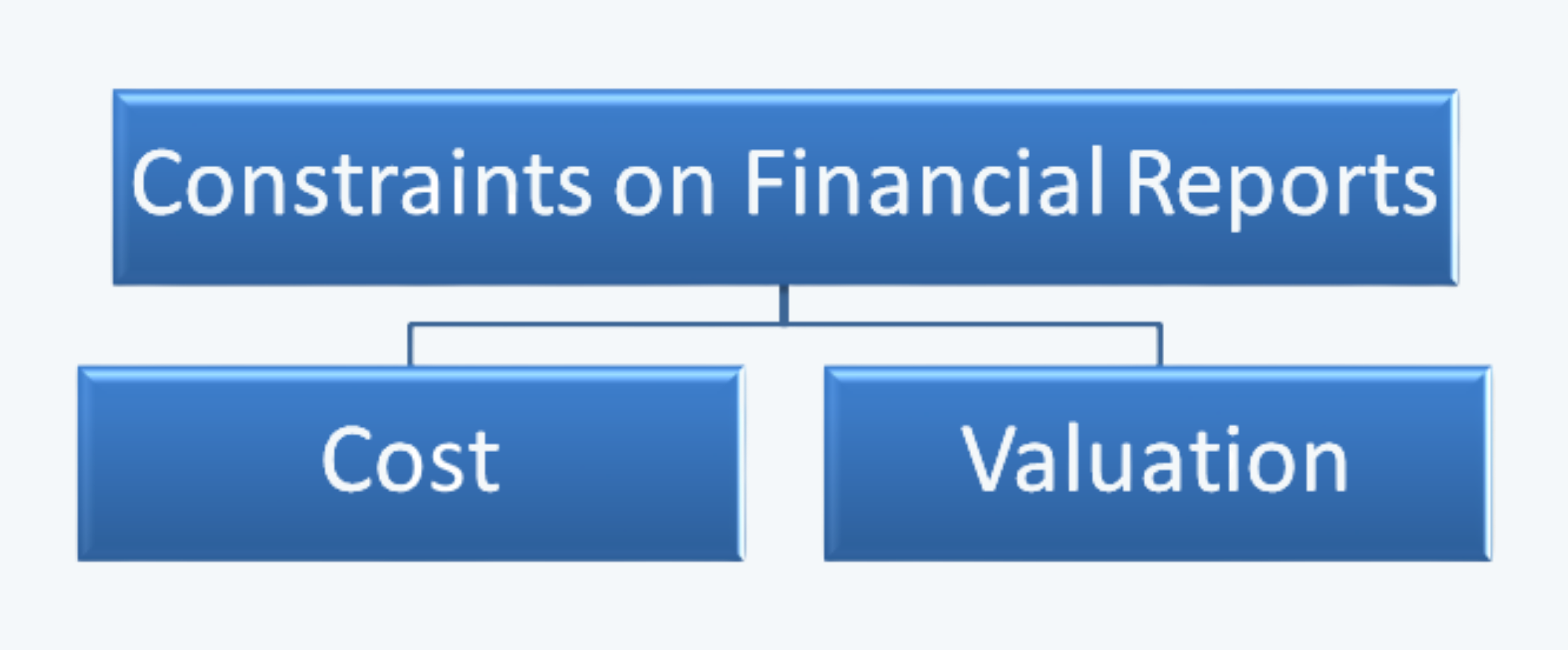
It is extremely desirable that the information be absolutely complete with all the desirable qualitative characteristics. However, there are certain constraints to the same. They are:
Constrants on Financial Reports FRA CFA Level 1 Study Notes

a.  The cost of the information. There is always a cost-benefit trade-off between the potential benefits that can be attained from information and the cost of making it available to its users in a complete form. Those responsible for providing the information should make sure that the cost of information shouldn’t exceed its potential benefits.

bValuing the Intangible. The information regarding the value of the tangible assets and liabilities can easily be identified. But, the non-quantifiable information about the intangibles is difficult to provide and is a big constraint towards providing qualitative information.

3.         Underlying Assumptions of the Financial Statements

There are two major assumptions of financial statements. They are:

a.  Accrual Accounting. This means that the accounting system does not record the transactions on a cash basis; rather they are recorded at the time of their occurrence.

bGoing Concern. It is assumed that the business of the entity is not going to cease at any time in the foreseeable future. Thus any events (such as the sale of major assets etc.) that indicate otherwise, should be reported separately as notes to accounts or otherwise, to give true and clear information about the entity.

4.         Recognition of Financial Statement’s Elements

Any element of the financial statements, whether it is an asset, liability, revenue, or expense, etc., should only be recognized if the following criteria are met by them:

a.  it is probable that any future economic benefit associated with the item will flow to or from the enterprise, and

b.  the item has a cost or value that can be measured with reliability.

5.         Measurement of Financial Statements Elements

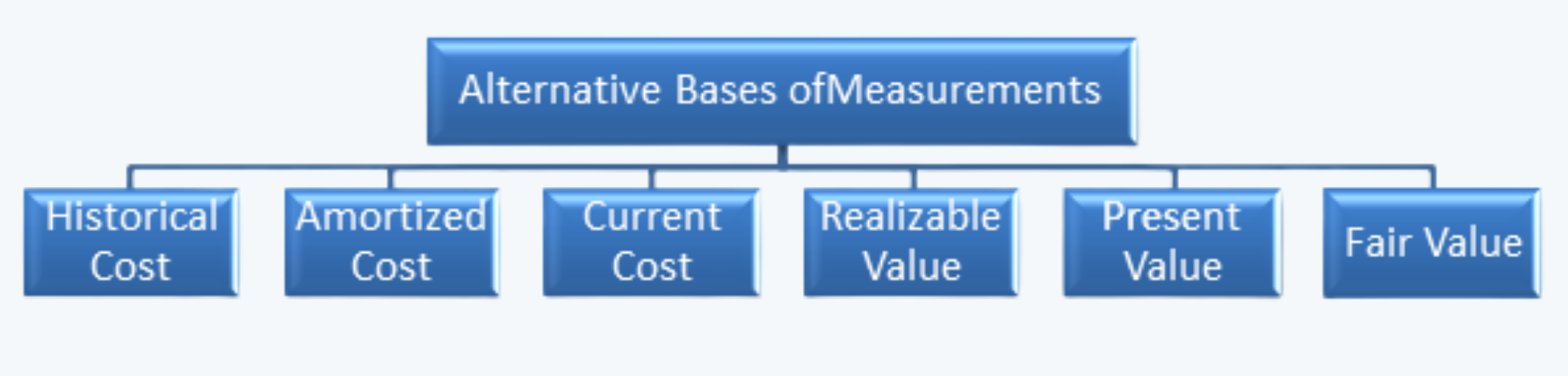
The values of the elements of the financial statements can be measured and recognized in the books of accounts using the following alternative basis of measurements:
Alternative Bases of Measurement FRA CFA Level 1 Study Notes

a.  Historical Cost. The historical cost is either of the following:

     i.  The amount of cash or cash equivalent paid to purchase and put the asset to use. This also includes the other cost of acquisition.

    ii.  If the asset was not purchased in cash, then the fair value of the asset given in barter to purchase the same.

b.  Amortized Cost. It is the historical cost of the asset, after adjusting for depreciation, amortization, or impairment.

c.  Current Cost. It is the cost to purchase the same or similar asset in the current market. For the liabilities, it is the amount required today to sell the asset.

d.  Realizable Value. This represents the amount that will be received /paid today to sell off the asset or settle the liability on the reporting date.

e.  Present Value. It is the discounted value of all the future benefits expected from an asset or the future obligations required to be paid or met in respect of any liability. The assets and liabilities are usually discounted at the cost of equity or the weighted average cost of capital.

f.  Fair Value. It is the value that would be fetched if the asset is sold or liability is settled between the two knowledgeable and willing parties at arm’s length price.

6.         Required Financial Statements

As per IAS No. 1, the following reports should be prepared to complete the set of financial statements:

a.  Statement of financial position or balance sheet;

b.  Statement of comprehensive income or income statement;

c.  Statement of changes in equity;

d.  Statement of cash flows; and

e.  Notes to accounts (summarizing the significant accounting policies and giving disclosures as required as per IFRS and other applicable statutes).

7.         General Features of Financial Statements

General Features of Financial Statement FRA CFA Level 1 Study Notes

The financial statements prepared under IFRS should be compliant with all its requirements. If however, it has to deviate from the same, necessary disclosures are required to be made.

As per the conceptual framework as reflected in the IAS No. 1, financial statements should have the following general features:

a.  Fair Presentation. The economic transactions and the elements of the financial statements should be reflected at their complete and fair value in the books of accounts.

b.  Going Concern. It is assumed that the reporting entity would continue its business at all times in the foreseeable future. If there is any deviation from this assumption it should be reported as disclosure in the books.

c.  Accrual Basis. All financial statements, except the cash flow statements, are prepared on an accrual basis.

d.  Materiality and Aggregation. All the information is considered material if it can influence the decision of its users. And, all material information should be reported separately unless they are not material.

e.  No Offsetting. All the assets and liabilities and income and expenses are not offset unless required or permitted by an IFRS.

f.  The Frequency of Reporting. Financial Statements should be prepared at least on an annual basis.

g.  Comparative Information. The comparative information of the previous period should also be reported along with the current year’s figures.

h.  Consistency. The presentation and classification of items in the financial statements are usually retained from one period to the next.