LOS A of Reading 30th requires us to:
calculate and interpret the weighted average cost of capital (WACC) of a
company
The weighted average cost of capital (WACC) is the average rate of return that a company earns for all its investors. It is the cost of capital that is weighted proportionately for each category of capital. WACC is also sometimes called the marginal cost of capital, as it is the additional cost that a company incurs for additional capital.
The capital structure of a company mostly comprises the debt capital and the equity. The equity can be of two types, i.e. preferential shares and common equity.
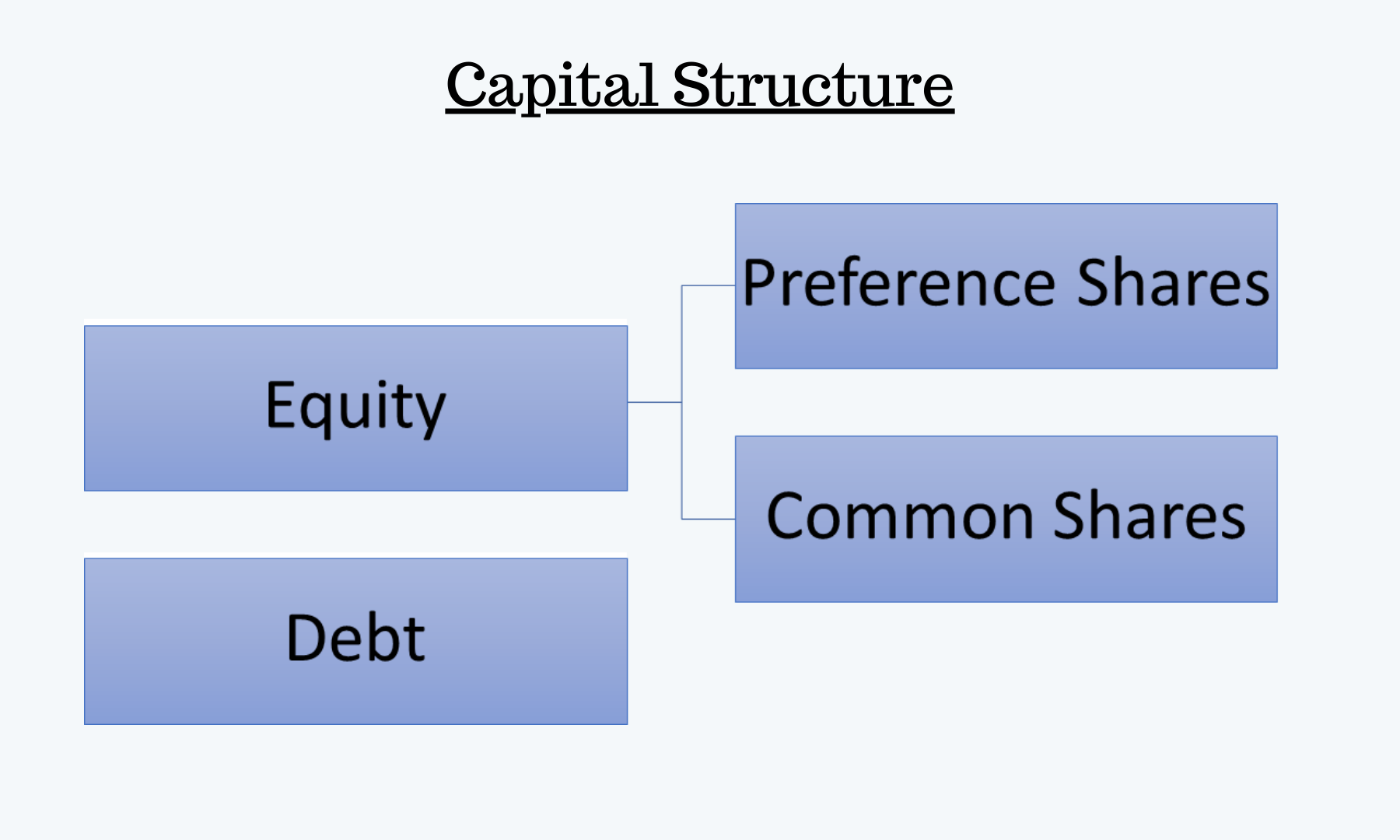
Each of these components of capital has its own cost.
Whenever a firm wants to make a new investment in a capital project, it requires new capital. Thus, to raise additional funds, the firm would need additional costs. This additional cost is referred to as the marginal cost of capital.
This marginal cost of capital is different from the cost of capital of the entire company. It is the required rate of return for the average risk on investment. From this average risk, we can modify and adjust the projects which are riskier in nature (in comparison to the average risk) to reflect their respective cost more accurately.
1. Calculation of Cost of Capital of Company
The calculation of the cost of capital is a two-step process:
- We first calculate the marginal cost of each component of capital, and
- Then weigh each such marginal cost.
In the form of an equation, we can write WACC as:
WACC = wdrd (1-t) + wprp + were
Where,
wd = the proportion of debt that the company uses when it raises new funds
rd = the before-tax marginal cost of debt
t = the company’s marginal tax rate
wp = the proportion of preferred stock the company uses when it raises new funds
rp = the marginal cost of preferred stock
we = the proportion of equity that the company uses when it raises new funds
re = the marginal cost of equity
For example, consider a company, XYZ Ltd. with the following capital structure and costs:
| Capital | Weight | Cost |
| Debt | 40% | 8% |
| Preference Shares | 10% | 9% |
| Common Shares | 50% | 12% |
Assuming the tax rate of 30%, the weighted average cost of capital would be:
= 9.14%
This means that if XYZ Ltd. wants to finance a new project, it will discount the cash-flows from such a project at an average cost of 9.14%, assuming that it would be financed in the same ratio, like that of the existing capital structure.
Check out more videos on our YouTube Channel.