LOS I requires us to:
identify the appropriate test statistic and interpret the results for a hypothesis test concerning the mean difference of two normally distributed populations
a. The independence of the sample has a huge impact on the difference in a mean or the mean difference parameter
b. If we have independent samples, the test of difference in means is done as follows:
i. If population variance is known, we use the population standard deviation to determine the statistic’s standard error. Otherwise, we use the sample standard deviation.
ii. When the variances of the population are not known and they are presumed the same, the standard error of the mean is calculated on a pooled basis and the degrees of freedom differ for two samples from the same population versus two from different populations.
c. The statistic to test the difference in mean of the independent samples are calculated as follows:
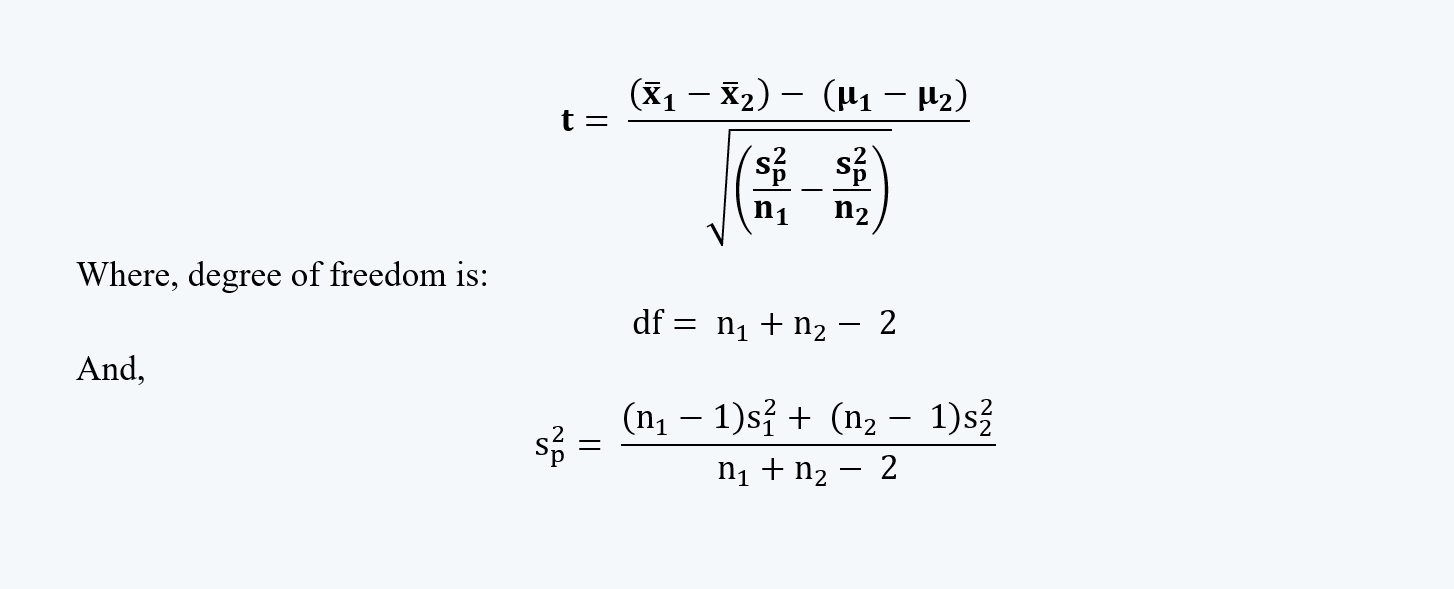
i. If the samples are normally distributed, equal but have unknown variances, we use a pooled variance estimator, sp2, which is a weighted average of the sample variances. The t-statistic is:
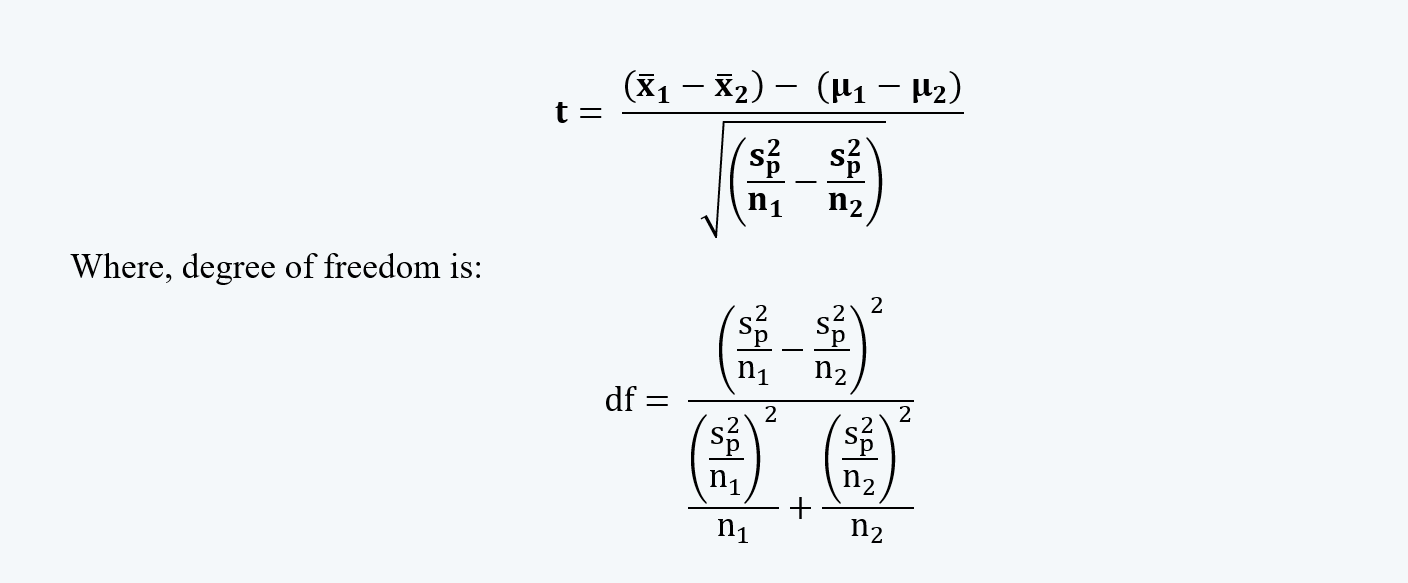
ii. If the independent samples are normally distributed, unequal, and have unknown variances, a different pooled variance estimator with a lower number of degrees of freedom is used.
The test statistic will be calculated as follows:
d. If we have dependent samples, we conduct the test of mean difference and use the variance of the differences in the test statistic
i. Here, we use the paired observations and test the mean difference across pairs.
ii. They are normally distributed with unknown variances.
e. The steps involved in the testing of mean differences for dependent samples is:
i. Calculate the difference for each pair of observations, as follows:

ii. Calculate the standard deviation of differences:

iii. Finally, calculate and match the test statistic: